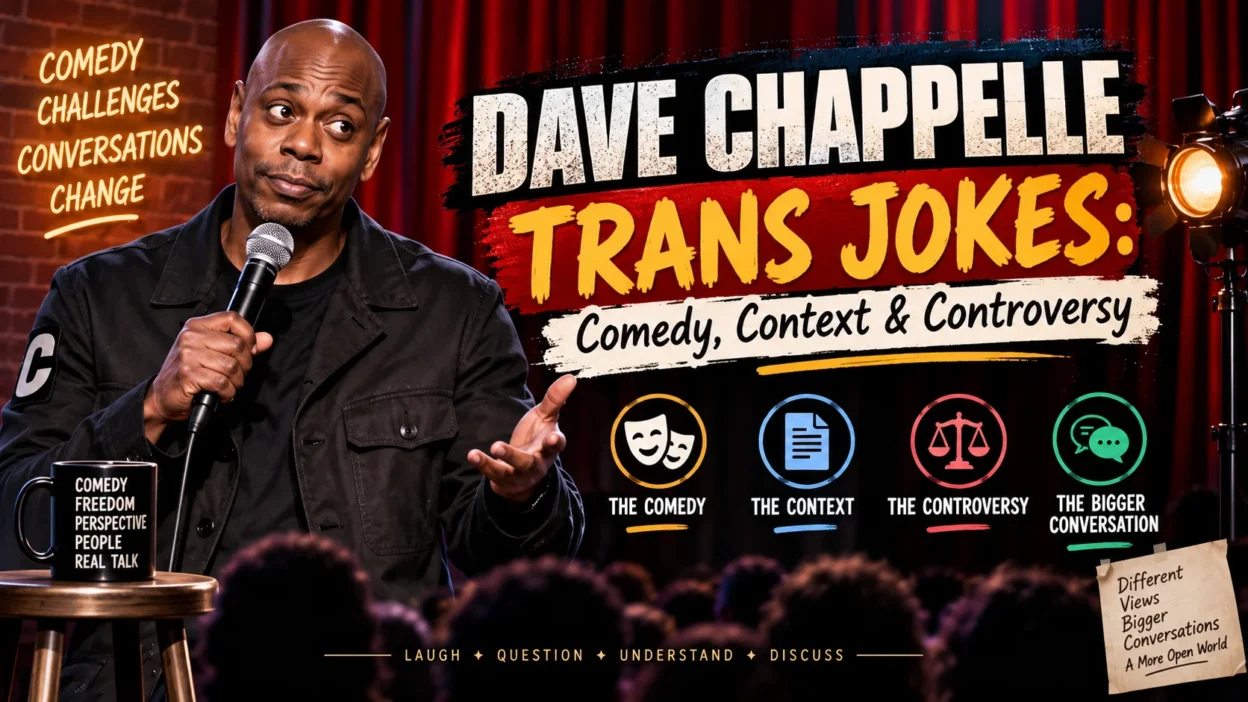
Dave Chappelle trans jokes became one of the most discussed subjects in modern stand-up comedy after the release of his Netflix special The Closer in 2021. The special included extended material about transgender identity, LGBTQ+ culture, and Chappelle’s own views on comedy, which generated both support and criticism.
Rather than simply collecting individual jokes, it is more useful to understand the context behind Dave Chappelle’s transgender-related comedy, why the material attracted controversy, how critics responded, and how Chappelle framed his own approach to humor.
Netflix categorizes The Closer as a 2021 stand-up comedy special featuring personal storytelling, social commentary, and pop-culture commentary.
🎤 Who Is Dave Chappelle?
Dave Chappelle is an American stand-up comedian known for observational comedy, satire, social commentary, and material dealing with race, culture, politics, sexuality, and celebrity.
His comedy frequently uses controversial subjects as material. That approach has been part of his public image for decades, with audiences often debating whether his jokes are intended primarily as satire, provocation, social commentary, or some combination of the three.
His Netflix special The Closer continued that approach. Netflix describes the special as Chappelle attempting to “set the record straight” while discussing subjects he wanted to address.
🏳️⚧️ Why Did Dave Chappelle Talk About Transgender Issues?
Transgender identity became a substantial subject in Chappelle’s later comedy, particularly in The Closer.
The material explored ideas surrounding:
- Gender identity
- Sexual orientation
- LGBTQ+ terminology
- Chappelle’s relationship with transgender people
- His views about comedy and offense
- The boundaries of controversial humor
- Public debates about free expression
- The relationship between comedians and their audiences
The important distinction is that the jokes were part of a larger comedic discussion, rather than simply being isolated jokes about transgender people.
📺 What Is The Closer?
Dave Chappelle: The Closer was released by Netflix in 2021.
Netflix lists it as a TV-MA comedy special and describes its style as personal storytelling, stand-up, social commentary, and pop-culture commentary.
The special attracted significant public attention because Chappelle devoted substantial material to LGBTQ-related subjects, including transgender identity.
The controversy surrounding the special became almost as widely discussed as the comedy itself.
🧩 What Were the Dave Chappelle Trans Jokes About?
The transgender-related sections of The Closer addressed several recurring themes rather than relying on one single joke.
Broadly, the material dealt with:
- Chappelle’s understanding of transgender identity
- His comments about gender and sexuality
- His relationship with transgender comedians
- The distinction he drew between different LGBTQ identities
- His interpretation of changing social norms
- The role of offense in comedy
- Whether comedians should be able to joke about sensitive subjects
Because the original special is copyrighted, reproducing long passages from it would not be appropriate. For readers interested in the actual performance, the complete special is available through Netflix.
😂 Why Does Chappelle Use Controversial Topics in Comedy?
Chappelle’s broader comedic style frequently involves subjects that can produce strong reactions.
His approach often uses exaggeration, irony, absurdity, and provocative observations. The purpose of such comedy can be interpreted differently by different viewers.
One audience member might see a joke as satire aimed at cultural assumptions, while another might interpret the same material as reinforcing a stereotype.
That difference in interpretation is an important part of the discussion surrounding controversial stand-up comedy.
⚡ Why Did The Closer Become Controversial?
The controversy was not simply about whether individual jokes were funny.
Critics argued that some of the material could contribute to negative stereotypes about transgender people. Supporters of Chappelle’s approach argued that comedians should be able to discuss controversial subjects without being prevented from doing so.
This created a broader debate involving:
- Comedy and artistic expression
- Representation
- LGBTQ+ rights
- Workplace culture
- Streaming platforms
- Audience expectations
- Freedom of expression
- The social impact of jokes
GLAAD, an LGBTQ media advocacy organization, has separately argued that media representation and portrayals of transgender people matter because entertainment can influence how audiences understand LGBTQ people.
🗣️ How Did Critics Respond?
Criticism came from LGBTQ advocates, entertainment figures, Netflix employees, and other commentators.
Critics generally focused on the potential impact of jokes involving transgender people and whether repeated stereotypes could contribute to an unfriendly or hostile cultural environment.
GLAAD has consistently advocated for more accurate and inclusive transgender representation in entertainment and has published guidance for journalists discussing transgender people.
These criticisms represent an advocacy perspective; they should be distinguished from Chappelle’s own explanation of his comedy.
🎭 How Did Chappelle Frame His Comedy?
Chappelle has repeatedly presented himself as a comedian who wants substantial freedom to discuss uncomfortable subjects.
In The Closer, his material addressed the idea that comedy should be allowed to challenge audiences and social conventions.
This reflects a broader philosophical disagreement within comedy:
Should comedians avoid certain subjects because jokes may hurt or marginalize people, or should controversial subjects remain available for satire and criticism?
There is no single answer accepted by every comedian, audience member, or advocacy organization.
🌈 What About the Transgender Comedian Daphne Dorman?
One particularly important part of the discussion involves Daphne Dorman, a transgender comedian who had interacted with Chappelle.
Chappelle referenced Dorman in The Closer while discussing transgender people and comedy.
Her inclusion in the special is significant because it complicated the public debate. Chappelle used the relationship to illustrate his argument that his material was not simply based on hostility toward transgender people.
Critics, however, could still disagree with the broader implications of his jokes.
That distinction is important: a comedian’s relationship with an individual does not automatically settle broader questions about how an audience interprets a comedy routine.
💻 What Happened at Netflix?
The controversy extended beyond viewers and critics to Netflix’s workplace.
Some Netflix employees objected to the special and organized a walkout in response to the company’s decision to distribute it.
The resulting discussion involved questions about:
- Employee speech
- Corporate responsibility
- Artistic freedom
- Content moderation
- Representation
- Workplace culture
- Streaming-platform policies
The situation became an example frequently cited in discussions about how technology companies and entertainment platforms handle controversial creative work.
🧠 Comedy, Intent and Impact
One of the most useful ways to understand the controversy is to distinguish intent from impact.
A comedian may intend a joke to be satire, but members of the audience can experience or interpret the joke differently.
Likewise, a joke can criticize a stereotype while some listeners interpret it as reinforcing that stereotype.
This is why debates over controversial comedy rarely end with simply asking:
“Was the comedian joking?”
The more complicated questions are:
- What was the joke trying to communicate?
- Who was the intended target?
- Who might interpret it differently?
- What assumptions does the joke depend on?
- Does the context change its meaning?
- How does the audience respond?
- Can satire criticize a stereotype while also being understood as endorsing it?
These questions help explain why The Closer produced such different reactions.
⚖️ Free Speech and Comedy
The controversy also raised broader questions about free expression.
Stand-up comedy traditionally gives performers significant latitude to discuss difficult subjects. At the same time, performers, audiences, employers, and platforms can disagree about the social consequences of particular material.
These are separate questions:
Legal question: Can the comedian legally perform or publish the material?
Social question: How will audiences react to it?
Ethical question: What responsibilities should comedians consider when discussing marginalized groups?
Business question: Should a platform distribute controversial material?
Keeping those questions separate makes the debate easier to understand.
📊 Why Are Dave Chappelle Trans Jokes Still Discussed?
The topic continues to appear in conversations about comedy because The Closer became a prominent example of the conflict between provocative comedy and concerns about representation.
It brought together several major cultural debates:
- Changing attitudes toward LGBTQ+ identities
- The evolution of comedy
- Freedom of expression
- Corporate content decisions
- Social-media reactions
- Representation in entertainment
- The responsibilities of public figures
For that reason, searches for Dave Chappelle transgender jokes often lead people to a much broader discussion of The Closer and its reception.
🔍 Dave Chappelle Trans Jokes vs. Transgender Representation
It is also important not to treat all transgender-related entertainment as equivalent.
A stand-up comedian discussing transgender issues is different from:
- A documentary about transgender people
- A transgender character in a scripted series
- A news report
- A personal story from a transgender person
- An LGBTQ advocacy campaign
- A comedy routine performed by a transgender comedian
Each format has a different purpose and context.
GLAAD’s entertainment research has specifically examined the quantity and quality of LGBTQ representation in film and television, including transgender and nonbinary characters.
📝 What Can We Learn From the Controversy?
The Closer debate demonstrates how comedy can become part of a much larger cultural conversation.
A controversial joke can raise questions about:
- Who gets to define offensive humor
- Whether intent matters more than impact
- How stereotypes work
- Where satire draws its boundaries
- How audiences interpret irony
- Whether streaming platforms have editorial responsibilities
- How marginalized communities respond to entertainment
These questions extend far beyond Dave Chappelle and apply to controversial comedy generally.
❓ Frequently Asked Questions
What are Dave Chappelle’s trans jokes about?
The transgender-related material in The Closer discusses gender identity, LGBTQ+ culture, Chappelle’s interactions with transgender people, and his views about comedy and offense. The material became controversial because critics and supporters interpreted its social meaning differently.
What Dave Chappelle special contains the transgender jokes?
The best-known example is Dave Chappelle: The Closer, released on Netflix in 2021. Netflix classifies it as a stand-up comedy special featuring personal storytelling and social commentary.
Why was The Closer controversial?
The controversy centered largely on Chappelle’s transgender-related material and disagreement over whether the jokes were legitimate satire or harmful representations of transgender people. The debate also expanded into questions about Netflix, workplace culture, and artistic freedom.
Did Netflix remove The Closer?
Netflix’s official listing currently identifies Dave Chappelle: The Closer as a 2021 comedy special.
Who is Daphne Dorman?
Daphne Dorman was a transgender comedian whom Chappelle discussed in The Closer. Her story became an important part of the discussion because Chappelle presented their relationship as an example of his personal connection with a transgender person.
Why do some people criticize Dave Chappelle’s transgender jokes?
Critics have argued that some of the material can reinforce negative stereotypes about transgender people or contribute to an environment in which transgender people feel targeted. LGBTQ advocacy organizations have emphasized the importance of responsible representation and avoiding harmful stereotypes.
Why do some people defend Chappelle’s comedy?
Supporters generally point to the tradition of provocative stand-up comedy and argue that comedians should be able to discuss sensitive subjects, challenge social conventions, and make audiences uncomfortable without automatically being treated as expressing literal hostility toward the group being discussed.
Is Dave Chappelle’s comedy considered offensive?
Different audiences have reached different conclusions. Chappelle intentionally uses provocative subjects, but whether a particular joke is considered offensive depends on the listener, context, interpretation, and personal values.
Is The Closer suitable for children?
Netflix lists the special as TV-MA, so it is intended for mature audiences rather than children.
What is the main debate around Dave Chappelle and transgender comedy?
The central debate involves the tension between creative freedom and the potential social impact of jokes about a marginalized group. Supporters emphasize comedic expression, while critics emphasize representation and potential harm.
Is Dave Chappelle transgender?
No. Dave Chappelle is a comedian who has discussed transgender issues extensively in his stand-up. His transgender-related comedy should not be confused with his own gender identity.
Where can I watch The Closer?
Netflix’s official catalog currently lists Dave Chappelle: The Closer.
Why is context important when discussing Chappelle’s jokes?
Context helps distinguish a comedian’s intended target, the surrounding story, the use of satire, and the audience’s interpretation. Quoting isolated lines can sometimes give a misleading picture of a longer stand-up routine.
🦊 Final Thoughts
The discussion surrounding Dave Chappelle trans jokes is ultimately larger than a collection of individual punchlines. The Closer became a significant case study in how modern audiences, comedians, advocacy organizations, employees, and streaming platforms can disagree about controversial comedy.
Chappelle’s approach emphasizes provocative social commentary and the freedom to discuss sensitive subjects. Critics have raised concerns about the effect of transgender-related stereotypes and representation. Both sides of that discussion are part of the documented history of the special.
For readers researching the topic, watching or reading about the material in its full context is more informative than relying on isolated quotes or social-media clips.

Jake Anderson is a humor writer and wordplay enthusiast who loves turning everyday phrases into clever puns. As the voice behind Punsbyte, he creates lighthearted and engaging content designed to make readers smile.
With a passion for witty humor and creative writing, Jake focuses on delivering short, punchy jokes that are easy to enjoy and share. His goal is simple — to bring a little laughter into your daily life, one pun at a time.